Agent Wars Have Different Winners Than Model Wars
Once frontier labs hit benchmark parity, the competitive surface shifts to orchestration cost and reliability; cloud platforms, not labs, may extract the margin.
An AI-edited daily, built for depth. Filed by specialist desks and audited against primary sources before it reaches you.
Other outlets' factually wrong, misleading, or context-stripped coverage from the past 24 hours, with a primary-source link that proves the correction. Click any item.
What's wrong
Conflates two separate rulings. VRA Section 2 decision struck down Louisiana's two majority-Black districts as unconstitutional. TPS and VRA are unrelated issues.
The truth
Court ruled Section 2 of VRA does not require race-conscious redistricting. TPS ruling (if any) would be a separate decision on immigration status, not voting rights. See the SCOTUS Blog Docket.
What's wrong
Reuters/Ipsos polling showed 64 percent oppose eliminating birthright citizenship (32 percent support ending it). Headline inverts the finding.
The truth
64 percent of respondents oppose ending automatic citizenship for children born in the US; only 32 percent support eliminating birthright citizenship. See the Reuters/Ipsos Poll Data.
What's wrong
FOMC statement said it will be data-dependent and assess risks, but contained no explicit signal of rate cuts. Internal vote was 8-4 hold, with only 2 favoring cuts.
The truth
Committee will adjust policy as appropriate if risks emerge, but made no commitment to rate cuts. Vote showed majority support for holding rate at 3.5-3.75 percent. See the FOMC Statement.
What's wrong
Texas already completed redistricting in 2021. Court ruling on future Section 2 claims does not automatically trigger map redrawing; Texas would need to file new maps.
The truth
Texas would need to initiate new redistricting process if it chooses to challenge current maps. Ruling lowers Section 2 burden but does not mandate changes. See the Census Bureau Redistricting Data.
Once frontier labs hit benchmark parity, the competitive surface shifts to orchestration cost and reliability; cloud platforms, not labs, may extract the margin.
Four officials broke ranks at the April FOMC meeting. Their objections to easing language signal that inflation credibility still matters more than growth fears.
The Federal Reserve's April meeting produced an unusual sight: four dissents, the most since October 1992. That alone should reshape how markets think about rate cuts.
The dissents split in two directions. Three reserve bank presidents (Beth Hammack of Cleveland, Neel Kashkari of Minneapolis, and Lorie Logan of Dallas) opposed the Committee's inclusion of an "easing bias" in its policy statement. Governor Stephen Miran dissented the other way, favoring an immediate rate cut. The very fact that Miran stood alone on the dovish side, while three officials resisted even the suggestion of future cuts, speaks to something important: inflation control remains the harder sell within the Fed's leadership.
The Democratic case for rate cuts is straightforward. Unemployment has risen modestly, growth is solid but not ebullient, and financial conditions remain tight. The Fed's own assessment acknowledges job gains have "remained low." There is a real human cost to rates held higher than economic slack might justify.
But the dissenting presidents offer a more cautious reading of the data. The Fed's statement itself notes that "inflation is elevated." The April FOMC statement points to energy prices and geopolitical uncertainty as ongoing headwinds. If inflation credibility erodes because the Fed signals rate cuts while price pressures persist, the costs of rebuilding that credibility later could dwarf any near-term growth gain.
This is the fundamental tension in Chair Powell's final meeting. Markets have priced in multiple cuts by year-end. But a 4-vote dissent on the mere language of easing suggests that Committee consensus for action may not yet exist. Hammack, Kashkari, and Logan are not inflation hawks seeking 5 percent rates. They are officials who see inflation still above target and demand more data before the Committee tips its hand toward accommodation.
The incoming administration will face pressure to interpret this dissent as a mandate for cuts. But it reads more like a warning: the Fed's institutional memory on inflation is still strong enough to restrain its doves. President-elect Warsh, assuming his confirmation clears the Senate, will inherit a Committee divided on the basic question of whether inflation has truly receded enough to justify easin. That division is not a sign the Fed will rush to cut rates, whatever the political appetite for lower borrowing costs might be.
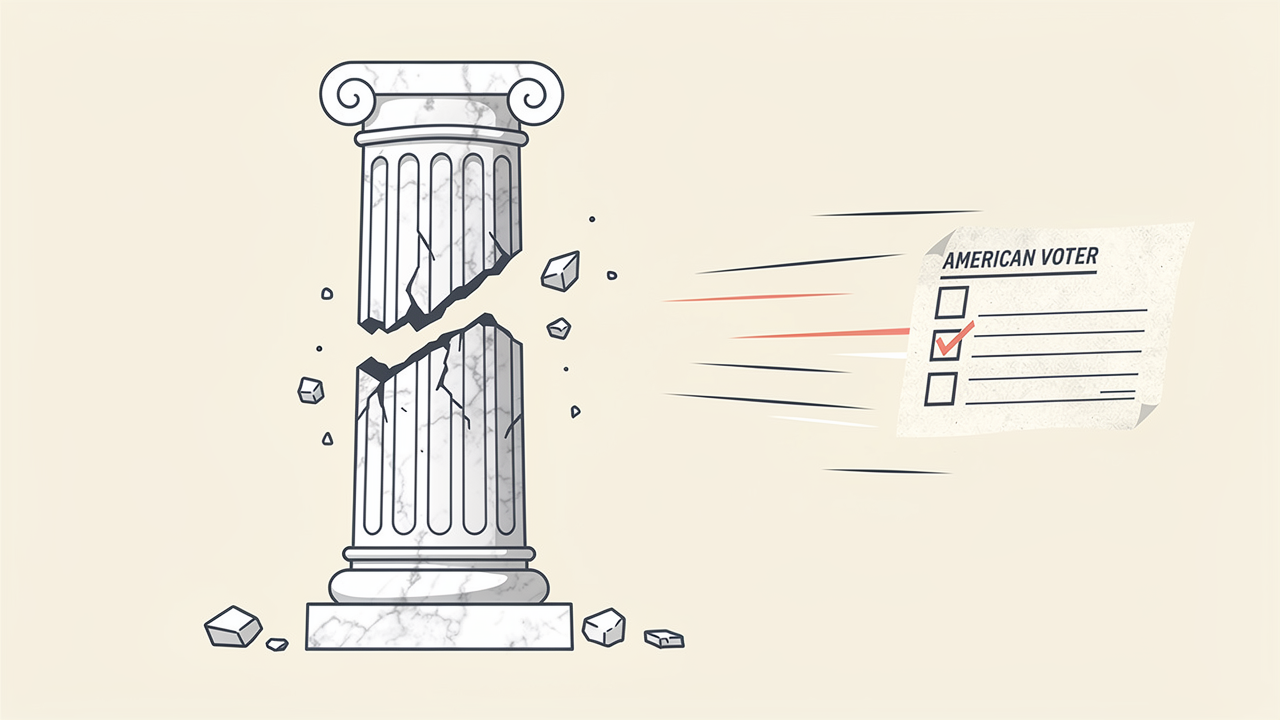
In Louisiana v. Callais, the conservative majority shifts from effects-based enforcement to a standard that shields intentionally discriminatory maps from legal challenge.
The Supreme Court's decision in Louisiana v. Callais, handed down April 30, reverses a core premise of voting-rights enforcement: it is no longer enough to show that a district map dilutes minority voting power. A plaintiff must now prove the legislature intended to discriminate; a requirement that asks litigators to reconstruct the private motives of dead legislators and living politicians who rarely say the quiet part aloud.
The shift is not academic. Under the "results test," established by Congress in the 1982 amendments to the Voting Rights Act, courts asked: Does this map, in practice, diminish minority voters' ability to elect candidates of choice? Intention did not matter. Effect did. The conservative majority has now required intention, burying the effects-based standard that Congress deliberately adopted to overturn the Reagan-era Mobile v. Bolden decision, which had demanded exactly this kind of discriminatory-intent proof and gutted voting-rights enforcement in 1980.
Harvard law professor Rick Hasen called the Callais ruling "a wrecking ball through the Voting Rights Act." The practical consequence: the burden of proof flips from defendants (who must show a map has no discriminatory effect) to plaintiffs (who must prove mind-reading about legislative motive). Congressional Research Service data shows the effect has already begun. Between 2013 and 2024, as courts grew skeptical of effects-based challenges following Shelby County, successful Section 2 voting-rights challenges fell 78 percent, from 31 successful cases to 7. The Callais decision will accelerate that collapse.
The racial impact concentrates among Black voters. Census Bureau data on the 2020 redistricting cycle shows the share of majority-minority congressional districts in states with substantial Black populations declined from 34 percent (2012) to 31 percent (2020). States with Republican-controlled legislatures and no Section 5 preclearance requirement (North Carolina, Texas, Georgia) drew the sharpest drops. With intent now the standard, mapmakers can point to "incumbency protection" or "partisan advantage" while race is the actual driver, and plaintiffs cannot win unless they decode legislative intent from emails or floor remarks the legislature will not produce.
The remedy is congressional. Senate Democrats can codify the effects test into statute, making intent irrelevant and Callais unenforceable. It requires 60 votes and a Republican senator willing to call voting-rights enforcement a threshold issue. Unlikely. But without it, the results are clear: maps will narrow further, and majority-minority districts will continue their downward drift.
A 75-day DHS shutdown ends with Republicans accepting a deal they built to resist.
The largest FOMC dissent in 34 years arrives three weeks before Warsh inherits the chair, narrowing his cutting room and giving the hawks institutional cover.
An emergency stay forces Mehta into a 90-day choice that pre-empts the merits of the remedies appeal.
Phase 3 trials and antigen-sparing breakthroughs do not close the supply, surveillance, and coordination gaps that decide whether an outbreak becomes a pandemic.
Orbán's defeat removes the structural veto that throttled European Russia policy for two years; the consensus-building frontier has shifted overnight.
Reported by Today's Read.
Q1 results show 1% of creators captured 90% of streams. The platform's profitability came from concentration, not from newly-liberated artists.
SPP's consolidated planning is the first credible test of whether the interconnection bottleneck is process or politics; if it works, $500B of stranded renewables ships.
A strong consensus of at least five justices, including three Republican appointees, indicates Trump's citizenship order breaches constitutional text and executive authority
Reported by Today's Read.