wire / desk
Fed Holds Rates as Four Governors Dissent; Warsh Advances to Senate Floor
Three credibility shocks landed in 26 hours: a four-way FOMC dissent, the most partisan Senate Banking Committee vote on a Fed chair on record, and a 4.5% Q1 inflation print. Warsh inherits a central bank without internal or political consensus.
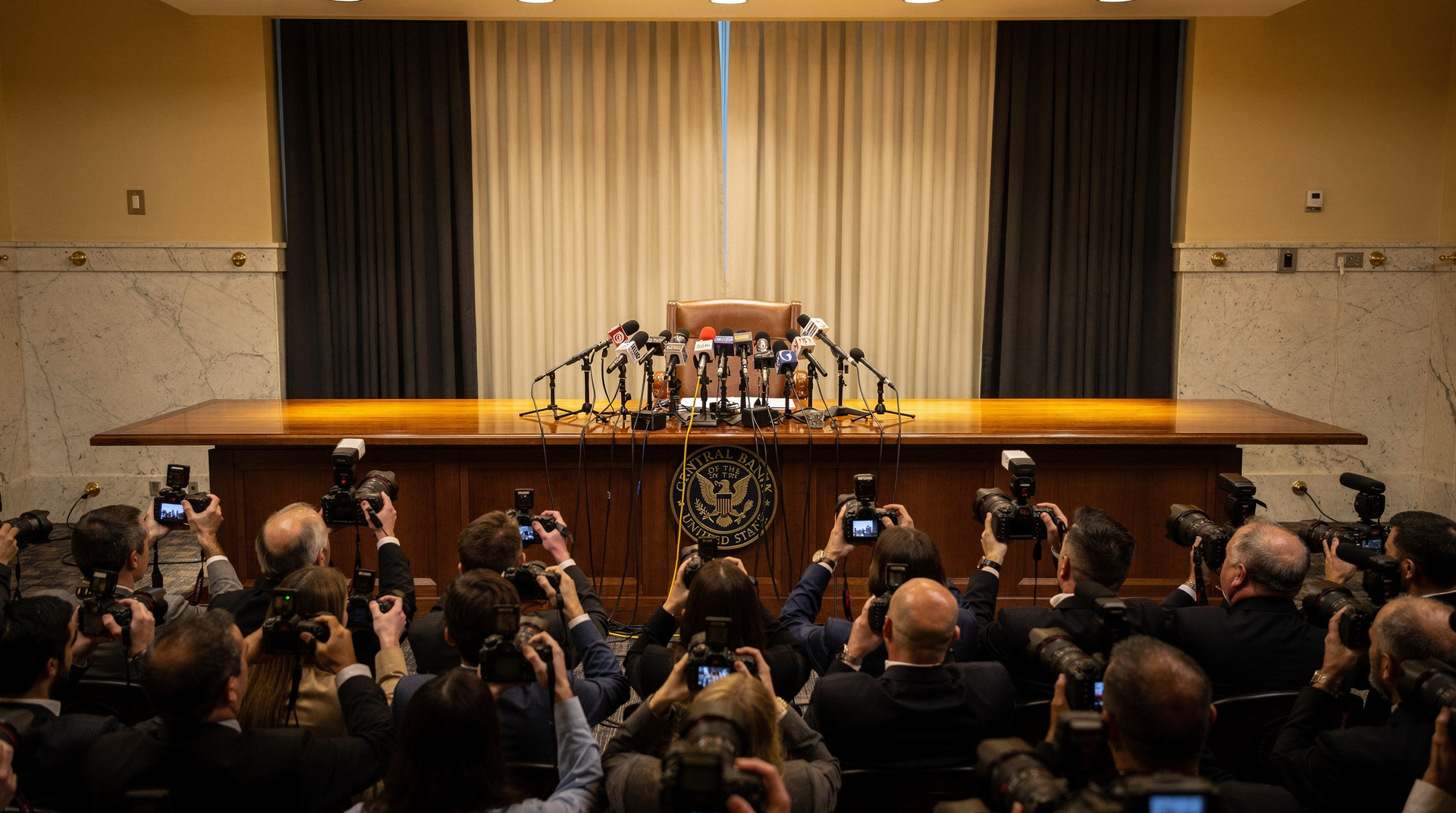
The Federal Reserve is entering its first chair transition since 2018 without internal consensus on the direction of rates, without bipartisan political cover for the incoming chair, and into a quarter that printed 4.5% annualized inflation. Those three conditions arrived inside a single 26-hour window between April 29 and April 30. They will not separate.
Jerome Powell’s final FOMC meeting on April 29 produced an 8-4 vote to hold the federal funds rate at 3.50 to 3.75 percent. The four dissents were the most since October 1992. Stephen Miran voted to cut a quarter point. Cleveland Fed President Beth Hammack, Minneapolis Fed President Neel Kashkari, and Dallas Fed President Lorie Logan voted to remove forward-guidance language that left a cut on the table for June. The board did not split over pace. It split over direction.
Hours earlier, the Senate Banking Committee voted 13-11 to advance Kevin Warsh’s nomination for Fed chair to the full Senate. Every Republican voted yes; every Democrat voted no. The 13-11 vote is reported as the first fully party-line committee vote on a Fed chair in the panel’s modern record; former Fed economist Claudia Sahm, in remarks reported April 30, flagged the partisan split as historically abnormal and criticized Warsh’s hearing demeanor as a disrespect she had never seen a Fed chair show in testimony. No prior Fed chair confirmation in the committee’s modern record (since 1977) has been identified in reporting as having cleared on a strictly party-line vote. The full Senate vote is expected the week of May 11. Powell’s term expires May 15.
The next morning, the Bureau of Economic Analysis reported real GDP grew at a 2.0% annualized rate in Q1 2026, below the 2.3% consensus, while the PCE price index rose 4.5% annualized, the highest quarterly print since 2022. Business equipment investment jumped 17.2%, driven primarily by information processing equipment, even as nonresidential structures investment fell about 6.7%, led by declines in manufacturing structures. The composition is the story: equipment-led capex carried the headline number while structures contracted.
What changed this week is not the rate path. The Fed will hold through summer regardless of who chairs it. What changed is the institutional ground Warsh will stand on when he takes the gavel. He arrives without a unified board, without a Senate floor vote that any Democrat is now publicly committed to, and into a data print that forecloses both directions of rate movement. A Fed chair operating without consensus, political cover, or a clear policy lane is a Fed chair whose forward guidance the bond market will price at a discount.
The dissent’s shape
The April 1992 parallel is misleading on the math and instructive on the structure. In October 1992, four FOMC members dissented over how fast Greenspan should keep cutting; the underlying question was pace, and the cutting cycle continued for another year. The April 2026 dissents are bidirectional. Miran wants the funds rate lower. Hammack, Kashkari, and Logan want the statement to commit the committee to holding longer. Averaging the four into a forward path produces a number that nobody on the committee actually wants.
Hammack and Kashkari have been consistent inflation hawks since 2022. Hammack rotated into a voting seat in January 2026 and has signaled in public remarks that she views the neutral rate as closer to 4 percent than 3.5 percent, which puts the current funds rate at or below neutral in her framework. Kashkari has argued repeatedly that the Fed should not cut until PCE has printed below 2.5% for two consecutive quarters. Logan, the Dallas president, has historically dissented on balance-sheet questions; her vote against forward guidance confirms the hawkish caucus has expanded beyond its 2025 core.
Miran’s dissent for cuts cuts in the opposite political direction from where it would be predicted. He is a Trump appointee who took his board seat in late 2025. The administration’s preferred policy position, communicated through public statements from the Treasury and the National Economic Council since January, has been that the Fed should be cutting. Miran is the only board member voting that line. The other Trump-aligned governor, Christopher Waller, voted with the majority to hold and to keep the easing language. Warsh, who has not voted yet, is publicly on record as more hawkish than Waller.
The internal arithmetic that matters for Warsh’s first meeting in June: of the eight votes for the majority, at least three (Waller, Governor Michelle Bowman, and Governor Adriana Kugler in her final months before her September departure) sit closer to the hawkish dissent than to Miran. If Hammack, Kashkari, and Logan formalize their dissent into an opposition bloc, the working majority for any cut narrows to four or five. That is the math Warsh inherits.
The partisan stamp
The Senate Banking Committee has reported out roughly a dozen Fed chair nominations since the modern committee structure was established in 1977. Reporting on the April 29 markup characterized the vote as the first in which no prior committee report on a Fed chair nomination had been delivered on a strictly party-line basis; former Fed economist Claudia Sahm, speaking publicly the next day, flagged the partisan split as historically abnormal and criticized Warsh’s hearing demeanor as disrespectful toward Democratic senators. Independent committee roll-call records consistent with that characterization include Volcker’s 1979 nomination, which passed 14-1 with the lone dissent procedural rather than partisan; Bernanke’s 2010 reconfirmation, the strongest contested vote of the modern era at 16-7, in which seven Democrats still voted yes; Powell’s 22-1 in 2018 and 23-1 in 2022; and Yellen and Bernanke’s first confirmations, both of which carried minority-party support.
Warsh’s 13-11 vote breaks that pattern. Senator Elizabeth Warren, ranking member, said in committee that Warsh’s record on regulatory rollback during his 2006 to 2011 governorship and his recent statements on Fed independence made him “the wrong chair for the wrong moment.” Senator Tim Scott, the chair, framed the dissent as a policy disagreement rather than a challenge to the institution itself. Both framings are correct; both miss the structural consequence. A partisan-stamped Fed chair carries a partisan ceiling. When the chair speaks, half the Senate has already voted that he should not be speaking at all.
That ceiling is not an abstraction. It governs three concrete capacities the Fed chair has historically relied on:
- Crisis discretion. The 2008 and 2020 emergency lending facilities required Treasury sign-off and tacit Senate non-objection. Bernanke and Powell built that non-objection into their pre-crisis relationship-building. A chair confirmed on a party-line vote enters office without that pre-built coalition.
- Personnel continuity. Fed chairs name regional Reserve Bank presidents indirectly through the FOMC reappointment process. Senate Democrats have signaled, in floor statements during the committee debate, that they will scrutinize every regional appointment Warsh signs off on. The chair’s bench is partisan-monitored from day one.
- Forward guidance credibility. When the chair says “the committee expects,” markets price the statement at the chair’s perceived ability to hold the committee. A 13-11 confirmation paired with a 4-vote dissent at the chair’s first meeting tells markets the committee is held only loosely.
The August 1979 contrast is sharp. Volcker arrived with 11.3% inflation, a deeper hole than 4.5% Q1 PCE, but with a 98-0 Senate vote behind him. When unemployment reached 10.8% in November 1982 and the funds rate was sitting above 14 percent, Volcker survived politically because both parties had voted for him. Warsh will not have that air pocket. If labor markets weaken in Q3 and he holds, Democratic senators will argue he is protecting tariff-driven inflation at the cost of jobs. If he cuts, Republican senators (and the dissenting hawks at the committee) will argue he is monetizing the trade war. The partisan vote pre-loads both attacks.
Stagflation-adjacent data
The Q1 GDP report on April 30 made the policy dilemma concrete. Real GDP grew 2.0% annualized, slower than the 2.3% consensus and roughly four times the 0.5% pace of Q4 2025. The acceleration is real. The composition is fragile.
Business equipment investment rose 17.2% annualized, with the BEA noting the increase “primarily reflected an increase in information processing equipment” tied to AI-related capital spending; nonresidential structures investment fell roughly 6.7% over the same quarter, led by manufacturing structures. Combined nonresidential fixed investment cleared a high single-digit annualized pace, but the equipment-versus-structures split is the relevant signal: AI-buildout spending is carrying the headline number while physical plant capex contracts. Yale Budget Lab analysis published April 8 estimated that effective US tariff rates rose to 13.5% in Q1 from 2.4% one year earlier, with further escalations scheduled for May and June; the structures contraction is consistent with companies postponing long-lead-time construction commitments under tariff uncertainty. The Atlanta Fed’s GDPNow tracker, updated April 30, projected Q2 growth at 1.4 percent before the GDP release; the consensus among private forecasters tracked by Bloomberg sits between 1.0% and 1.5% for Q2.
The PCE side is harder to discount. Headline PCE rose 4.5% annualized in Q1, core PCE (excluding food and energy) 4.3%, per the BEA advance estimate. Tariff pass-through into consumer goods prices has been the principal driver since January. The three-month annualized rate of core goods PCE, which strips out services and shelter, was 6.8% in March, the highest since the second half of 2022.
The matrix Warsh inherits: growth running at trend but compositionally fragile (equipment up, structures down), inflation running at more than twice the 2 percent target, the underlying tariff escalation continuing through May and June. A cut into 4.5% PCE is a credibility loss the Fed will not take. A hike into a Q2 growth print likely below 1.5% would shock the market and contradict every public statement the administration has made about Fed policy. Holding is the path of least resistance, which is precisely what the April 29 statement did. The dissent revealed that even holding does not command consensus.
What Warsh’s June meeting will actually decide
The June FOMC meeting falls roughly six weeks after Warsh’s expected swearing-in. The decision on rates is constrained by the data; whatever the May payrolls and CPI prints show, the committee is unlikely to move at Warsh’s first meeting. What will move is the dot plot and the press conference.
The Summary of Economic Projections at the June meeting will be the first read on whether the dissent has hardened. If Hammack, Kashkari, and Logan submit dots above the median for end-2026, and Miran submits a dot below, the committee will be visibly split on paper. Warsh’s press conference will be the first chance markets get to price his communication style. Powell built a 12-year track record of acknowledging dissent without legitimizing it; Warsh enters with no such track record and a board that has explicitly stated its disagreement on direction.
The bond market is currently pricing one 25-basis-point cut by December 2026, per the CME FedWatch tool as of April 30. That pricing assumes a unified Fed eventually moves. The April 29 dissent and the partisan confirmation mean the cost of the move, in committee management and political exposure, is underpriced by the bond market. If Warsh signals that he sees the hawkish dissent as a policy constraint rather than noise, the December cut probability falls. If he signals he will override it, the dissent crystallizes and the floor vote in May becomes the warm-up to a year of bipartisan attacks on the chair.
There is a third path: Warsh holds the line on data dependence and does not move at all in 2026. That outcome is closer to the hawkish dissent’s policy preference, would defuse the inflation political risk, and would push the policy fight into 2027 when Q1 tariff effects have either washed through or compounded. The cost is a slowing economy with a Fed that markets read as paralyzed.
The credibility question
Three institutions of Fed credibility took simultaneous hits this week. Internal consensus, which holds that the chair speaks for the committee, broke on April 29. Bipartisan political cover, which holds that the chair survives recessions because both parties confirmed him, broke at the committee on the same day. Data credibility, which holds that the dual mandate is achievable on the current policy path, took a hit when 4.5% PCE printed alongside slowing growth on April 30.
None of those is independently catastrophic. Fed chairs have presided over board dissents (Greenspan in 1992, Bernanke through 2008, Powell in 2024). Fed chairs have faced partisan opposition (Bernanke in 2010 took seven Democratic dissents). Fed chairs have walked into stagflation prints (Volcker in 1979). What is new is the simultaneity. Warsh enters with all three loaded at once, and the institutional repair tools (committee unity, Senate goodwill, data clarity) are not available to him on day one.
The market will price this gradually. The yield curve will flatten if growth slows; term-premium will widen if Fed credibility is questioned. The dollar will find a directional floor only when the policy path becomes legible. None of those moves will happen in May. They will happen across June and July as Warsh’s first meetings, dot plots, and press conferences accumulate evidence about whether he can rebuild the institutional ground Powell is leaving him.
The April 29 vote is not the start of the rate cycle. It is the start of the credibility cycle. Both will run together for at least a year.